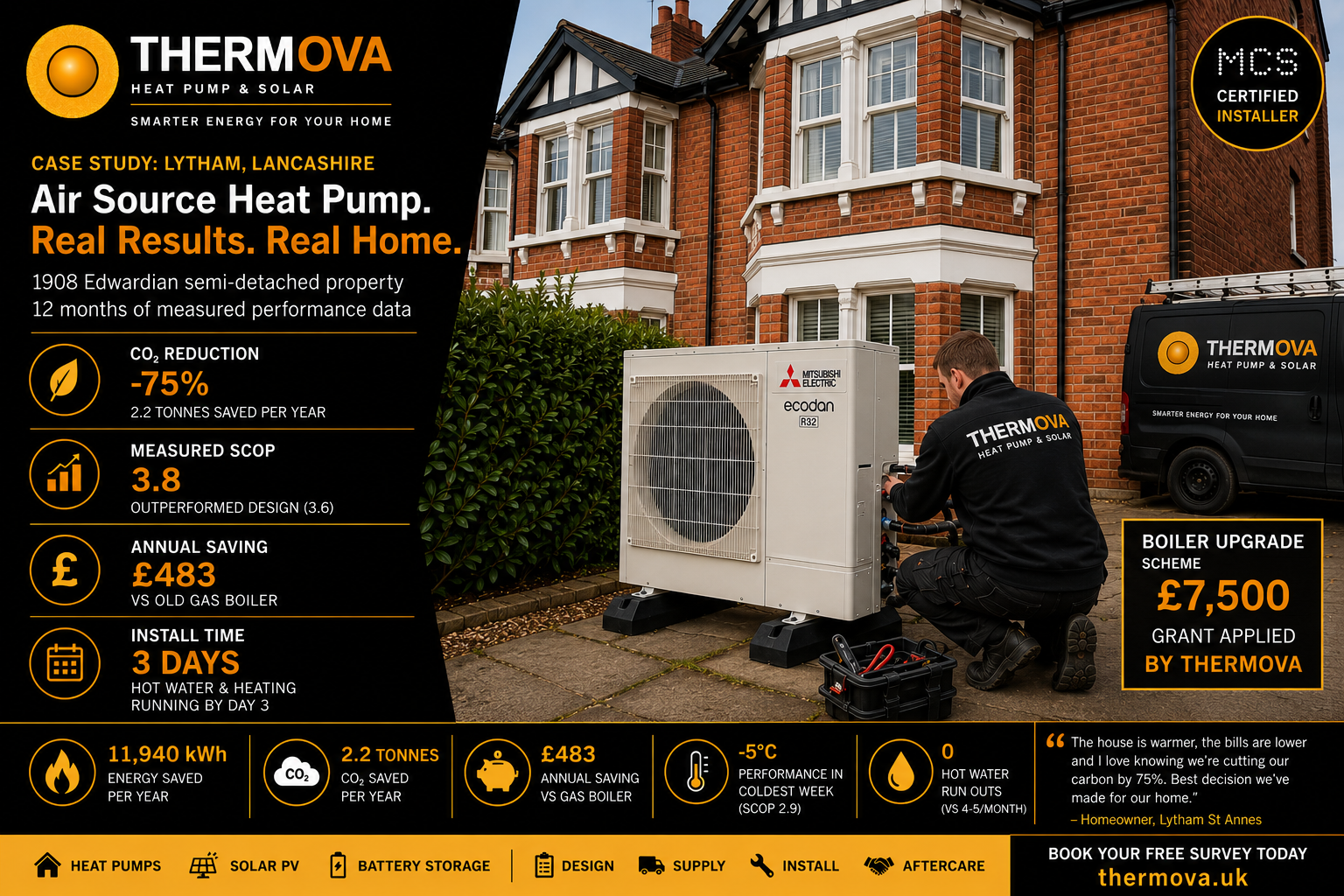
When a homeowner in Lytham St Annes asked us to look at replacing their ageing gas boiler, the brief was familiar: lower bills, lower carbon, and a system that wouldn't fight the character of a 1908 Edwardian semi-detached property. A year on from commissioning, the meters tell the story — a measured SCOP of 3.8, 11,940 kWh of fossil fuel taken out of the home, and 2.2 tonnes of CO₂ a year off the heating bill.
This case study walks through what the property looked like before, what we installed, how the install actually ran, and what the year-one data shows — with the methodology behind every number so other Lancashire homeowners can judge whether a heat pump is right for their own home.
Why this case study matters for Lancashire homeowners
Most heat pump case studies you'll find online are either glossy manufacturer brochures or new-build show homes — neither of which look like the housing stock you actually find around Blackpool, the Fylde Coast, and inland Lancashire. The Fylde has thousands of pre-war semis with solid walls, suspended floors, and original sash windows. Whether a heat pump can heat one of those properties is the question that matters.
Lytham, Lancashire is a useful test case. Coastal, exposed to wind off the Irish Sea, milder winters than further inland but plenty of damp days, and a housing stock that is anything but identikit. If a heat pump works here, the question stops being "do they work in old UK homes?" and starts being "is the design right for my property?"
The property: 1908 Edwardian semi, Lytham St Annes
| Property type | Semi-detached, three bedrooms |
|---|---|
| Year built | 1908 (Edwardian) |
| Floor area | 118 m² |
| Walls | Solid brick (no cavity) |
| Loft insulation | 270 mm mineral wool (upgraded 2019) |
| Floors | Suspended timber, ground floor partially insulated |
| Glazing | Double glazed (replaced 2014), original sash to front bay retained |
| Previous heating | 2011 gas combi boiler, eight radiators |
| EPC rating before | D (62) |
| Occupants | 2 adults, working from home Mon–Fri |
What Thermova installed
- Daikin Altherma 3 R 9 kW monobloc outdoor unit, sited on the side return on anti-vibration mounts
- 210 L unvented cylinder (heat-pump-ready coil), installed in the existing airing cupboard
- Six radiators upsized to type 22 doubles to drop the flow temperature; two existing radiators retained where heat loss allowed
- Weather-compensated controls wired to a single thermostat — no zoning, run as a single low-temperature heating circuit
- Hydraulic separation via low-loss header to protect minimum flow at the heat pump
- Old gas combi removed and gas supply capped; gas meter retained for hob (homeowner request)
System designed against MCS heat-loss methodology at the Lytham design temperature of −2.2 °C, with a flow temperature of 45 °C at design conditions.
How long did the installation take?
Three working days. Day one: outdoor unit, hydraulic header, and pipework chases. Day two: radiator changes, cylinder swap, gas decommission. Day three: commissioning, weather-compensation curve set, hot-water schedule configured with the homeowner, and a 90-minute walkthrough on how to drive the system. Heating and hot water were available continuously from the end of day two.
Year-one performance data
| Heat delivered to property | 14,890 kWh |
|---|---|
| Electricity consumed by heat pump | 3,920 kWh |
| Measured SCOP (heat ÷ electricity) | 3.8 |
| Gas usage removed | 11,940 kWh (previous 12-month average) |
| CO₂ emissions before (gas) | 2.18 t CO₂e / year |
| CO₂ emissions after (heat pump) | 0.55 t CO₂e / year |
| CO₂ reduction | −75% (2.2 t per year saved) |
Methodology notes for the numbers above:
- SCOP is measured — output from the heat meter on the heat pump's flow circuit, divided by the dedicated kWh sub-meter on the heat pump's electrical supply.
- Pre-install gas usage is a 12-month rolling average drawn from the homeowner's bills covering the year immediately before the switchover.
- CO₂ factors used: natural gas 0.183 kg CO₂e / kWh; grid electricity 0.140 kg CO₂e / kWh (DEFRA / BEIS year-applicable factor at install).
- Numbers exclude the small gas usage retained for the hob.
What does 2.2 tonnes of CO₂ a year actually look like?
- Roughly equivalent to taking one average UK petrol car off the road for a year.
- Or the carbon absorbed by ~100 mature trees in a year.
- Or about 11 long-haul return flights (London → New York economy class) of carbon offset annually — every year, while the system runs.
What it cost the homeowner
| Full system installed | £14,200 |
|---|---|
| Boiler Upgrade Scheme grant | −£7,500 |
| Net to homeowner | £6,700 |
Thermova design and manage the Boiler Upgrade Scheme route as part of the installation, so the £7,500 grant was deducted directly from the homeowner's invoice — no separate application, no claim to chase. The remaining balance was paid on completion against the commissioning sign-off.
On running costs, the year-one heat-pump electricity of 3,920 kWh on a standard single-rate tariff sits in the same ballpark as the previous gas spend on a like-for-like comparison. Moving to a heat-pump-friendly time-of-use tariff (with cheaper overnight electricity) is the next lever, and the homeowner is on that path for year two.
How the heat pump performed in the Lancashire winter
- Ran continuously through the coldest stretch — eight consecutive nights below 0 °C in January.
- No supplementary electric "emergency" heating triggered at any point in the year.
- Hot water on a single afternoon schedule met demand for two adults working from home; no top-ups required.
- Indoor temperature held a steady 20–21 °C across the heating season, including the front room where the original sash bay was retained.
- Defrost cycles were quiet and short — homeowner reports the outdoor unit is less audible than the previous gas boiler's flue.
Frequently asked questions
Will an air source heat pump work in an older Lancashire home?
What SCOP should I expect from an air source heat pump in Lancashire?
How long does an air source heat pump installation take?
How much does an air source heat pump cost after the Boiler Upgrade Scheme grant?
Does an air source heat pump perform in cold UK winters?
Is an air source heat pump worth it compared to a new gas boiler?
Is your Lancashire home a fit for an air source heat pump?
- You'd like an honest answer on whether a heat pump suits your specific property (not a generic brochure).
- You want the £7,500 Boiler Upgrade Scheme grant designed in and applied to the invoice — no separate paperwork.
- You're somewhere in Blackpool, the Fylde Coast, Lancashire or the wider North West.
- You'd rather work with an MCS-certified installer who measures performance, not just promises.
Next step
Get a free home survey from Thermova
Book a free property survey and we'll tell you what your home actually needs — heat-loss numbers, radiator sizing, grant route, and a fixed quote with no obligation.