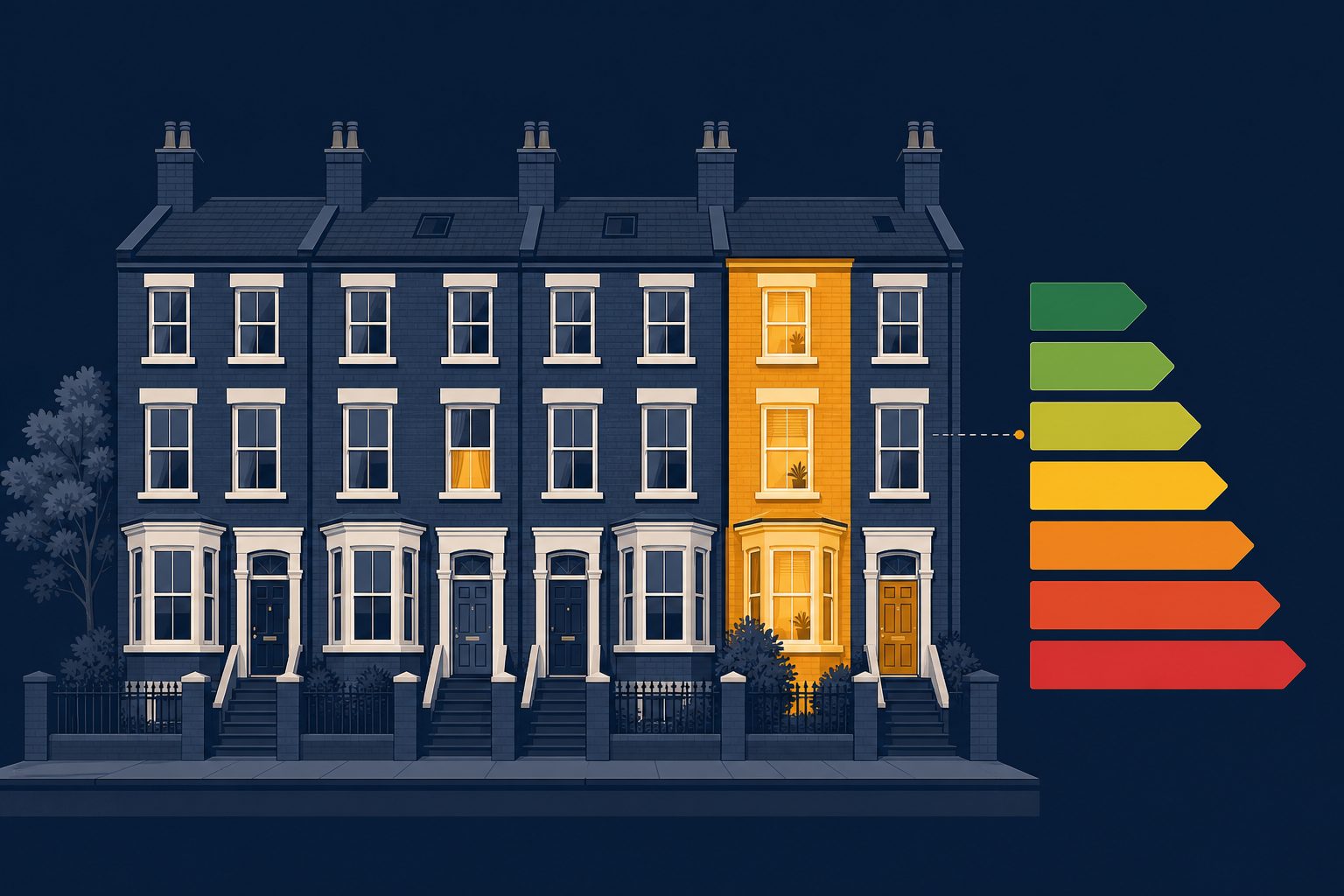
Flats are where the 2030 EPC C rules bite hardest and where certificates are most often wrong. Every self-contained flat carries its own EPC and its own obligation, and flat assessments lean more heavily on assumed values than houses because so much of the fabric, party walls, floors above and below, communal structure, cannot be visually verified. The result: portfolios full of mid-D certificates on flats that may already perform at a C.
The unit of compliance is the flat, not the block
A converted building with six flats is six dwellings, six EPCs and six 2030 deadlines. That sounds like more of a problem; in practice it is more of an opportunity, because each flat can be assessed, tested and corrected individually. There is no need to co-ordinate the whole block, involve the freeholder in works, or wait for a communal retrofit project that may never happen.
Why flat EPCs carry so many assumed values
An assessor in a mid-floor flat can verify the boiler and the windows, but not what is inside the party walls or between the floors. The methodology fills those gaps with age-band defaults, and defaults are cautious. A 1900s block that has been maintained, re-windowed and draught-sealed for a century is routinely tighter than its defaults assume. Our guide to assumed values explains the mechanism; the short version is that the certificate scores the assumption, not the flat.
Testing a single flat
Under RdSAP 10 a flat is tested as a standalone dwelling. Thermova's Pulse equipment is carried in by hand, the test takes around two to three hours, tenants can stay in, and nothing about the communal building is touched. Where the measured result beats the default, a qualified Domestic Energy Assessor lodges the corrected EPC for that flat on the national register. That is the £500 no-C-no-charge service, and it scales cleanly across a portfolio: send the address list, and only the flats where pre-screening says a C is realistic get tested.
Where HMOs stand
HMO rules are messier, and honesty matters here. Where an HMO is let as one self-contained dwelling, or is made up of self-contained flats, EPC obligations apply in the normal way. Individual room lets in a shared house currently fall outside the EPC requirement because a single room is not a self-contained dwelling. Government has consulted on tightening standards across the rented sector, so treat that position as current rather than permanent, and check guidance before building a strategy on it. What is certain: any self-contained unit you let needs its certificate sorted by 1 October 2030.
A portfolio playbook for flat landlords
- Pull every flat's EPC from the register and sort by score.
- D63 to D68 with assumed entries: shortlist for measured testing first, it is the cheapest possible fix.
- Lower Ds and Es: price the routes with our cost comparison before committing capital.
- Keep certificates and invoices organised per flat, the same evidence serves compliance or a future exemption.
Frequently asked questions
Does every flat need its own EPC?
Can you air test a single flat, or does the whole building need testing?
Why do flats so often sit at D with assumed values?
Do HMOs need an EPC C by 2030?
Does the freeholder need to be involved?
Next step
Got a block's worth of D-rated flats?
Send the addresses and Thermova will pre-screen every certificate on the register, then test and lodge only the ones where a C is realistic. £500 per property, charged only on success.