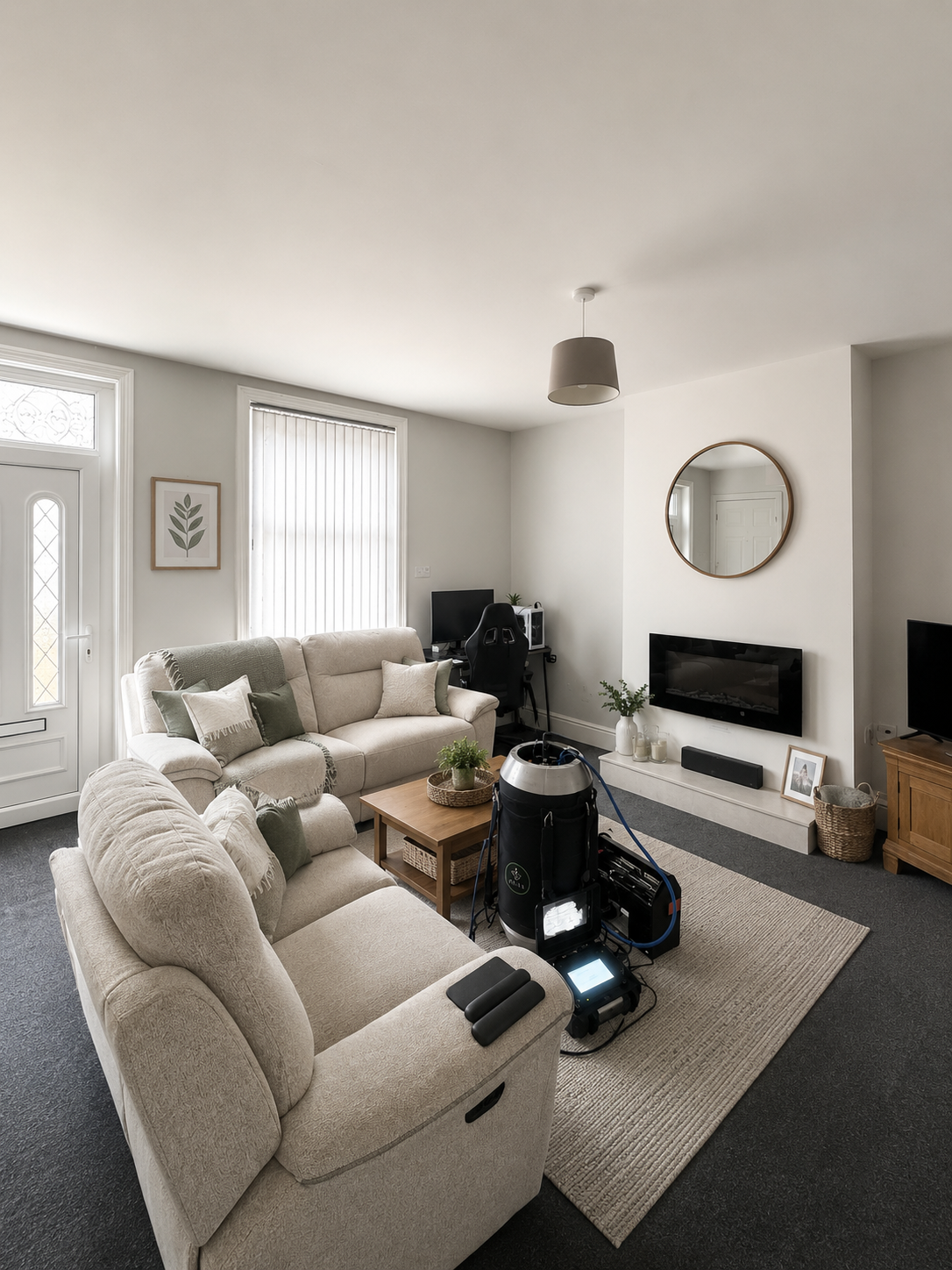
Getting a rental from EPC D to C does not always mean a heat pump or a new boiler. Sometimes it is a couple of targeted steps and an accurate measurement of what the building is really doing. Here is a real example. A semi-detached house in Audenshaw, Greater Manchester, sat on a D for years. A loft insulation top-up and a measured Pulse air test, reassessed under the current EPC methodology, moved it up to a C. The figures below come straight from the public EPC register and the test report, so you can check them yourself.
The property
A three bedroom semi-detached house of the kind you find on any street across the North West, built in the 1967 to 1975 age band, with 85 square metres of floor area and a 228 square metre envelope. Mains gas, boiler and radiators, filled cavity walls and double glazing. Privately let, and like a lot of rentals it had been assessed years earlier on a mix of measured and assumed values.
Where it started
The original certificate, lodged in November 2020, put the property at a D with a score of 67. That is a high D, only two points below the 69 you need for a C. Two things stood out on that old certificate. The loft had 100 mm of insulation, which the assessment rated as no better than average. And the airtightness of the building was never measured. As with most EPCs, the software used its default assumption of 15 m3/h.m2, because nobody had tested it. That default is deliberately pessimistic, and it almost always works against you.
What we did
The work was aimed squarely at those two weak points. First, the loft insulation was topped up from 100 mm to 300 mm. Loft insulation is one of the cheapest and most effective ways to lift a rating, and getting to 300 mm took that feature from average to very good. Second, we carried out a measured air test using Pulse, the low pressure pulse method, under CIBSE TM23. For an occupied rental that matters. There is no fan strapped into the front door and no hours of set up. The unit releases a known quantity of air, measures the building's pressure response, and the whole thing is done in a single visit with minimal disruption to the tenant. The property was then reassessed under RdSAP 10, the current EPC methodology, which allows a measured air permeability result to be entered in place of the default assumption.
The numbers
The test was carried out on 11 August 2026. Because Pulse measures at 4 Pascals rather than 50, the report gives both figures:
Measured at 4 Pa
Extrapolated to 50 Pa
RdSAP default
0.60 m3/h.m2 3.26 m3/h.m2 15 m3/h.m2 Air permeability is conventionally quoted at 50 Pa, so 3.26 is the figure that goes into the assessment. Elmhurst describes a result around 3 to 4 as very good. Against a default assumption of 15, that is a substantial correction, and it was there all along, just never measured.
The result
The reassessment came back at a C with a score of 72. That is comfortably over the line, not scraping it. The modelled carbon emissions on the new certificate are 2.7 tonnes a year, against 4.2 tonnes on the old one. Some of that gap is the change in methodology between the two assessments, which were six years apart and use different fuel emission factors, so it is not a like-for-like comparison. But the direction and the rating uplift are real. What makes the result more striking is that the current methodology scores some features less generously than the old one did. The property reached a C anyway, because the two things we changed, the loft and the airtightness, more than made up the difference.
Why the timing matters more than the score
The new certificate was lodged on 19 August 2026 and runs to 18 August 2036. Under the confirmed Minimum Energy Efficiency Standard, privately rented homes in England and Wales must reach EPC C by 1 October 2030, with a cost cap of 10,000 pounds per property before an exemption can be registered. The requirement applies to all tenancies from the same date. The detail most landlords have missed is this. A certificate at C or above, lodged under the current metrics before 1 October 2029, counts as compliant until it expires. This one was lodged in August 2026, so the property is compliant through to 2036 without being reassessed under the reformed EPC that is coming. Getting an accurate certificate now is worth more than getting one later.
What this actually shows
The lesson here is not that an air test is magic. It is that accurate data and a couple of well chosen improvements beat guesswork. The old certificate was holding the property down in two ways. It assumed the worst on airtightness, because the building had never been tested, and the loft was genuinely under-insulated. Fixing the real weakness in the loft, and measuring the real airtightness instead of assuming 15, was enough to move a high D into a solid C. For a property that is already close, that combination is often far cheaper than the heat pump or the external wall insulation people assume they need.
What it means for landlords
If you have a rental sitting on a high D, it is worth finding out two things before you spend on anything big. What is your loft actually doing, and has the airtightness ever been measured or just assumed? Very often that is where the cheap points are hiding. We check the certificate first, tell you which measures will genuinely move your rating, and only take on the work where it stacks up. On the air test itself, our terms are simple. EPC C or no fee, subject to our published terms.