Pulse air tightness testing measures how much air a building really leaks, using a short burst of compressed air instead of a fan sealed into the front door. It is fast, non-invasive, accepted for Building Regulations Part L sign-off, and under RdSAP 10 its verified results can replace the assumed air-leakage defaults on an existing home's EPC.
Thermova is ATTMA Level 1 accredited and runs its own Pulse equipment across Lancashire and the North West, on two very different jobs: signing off new-build plots for developers, and lifting D-rated rental properties to a C with measured evidence.
How does a Pulse test actually work?
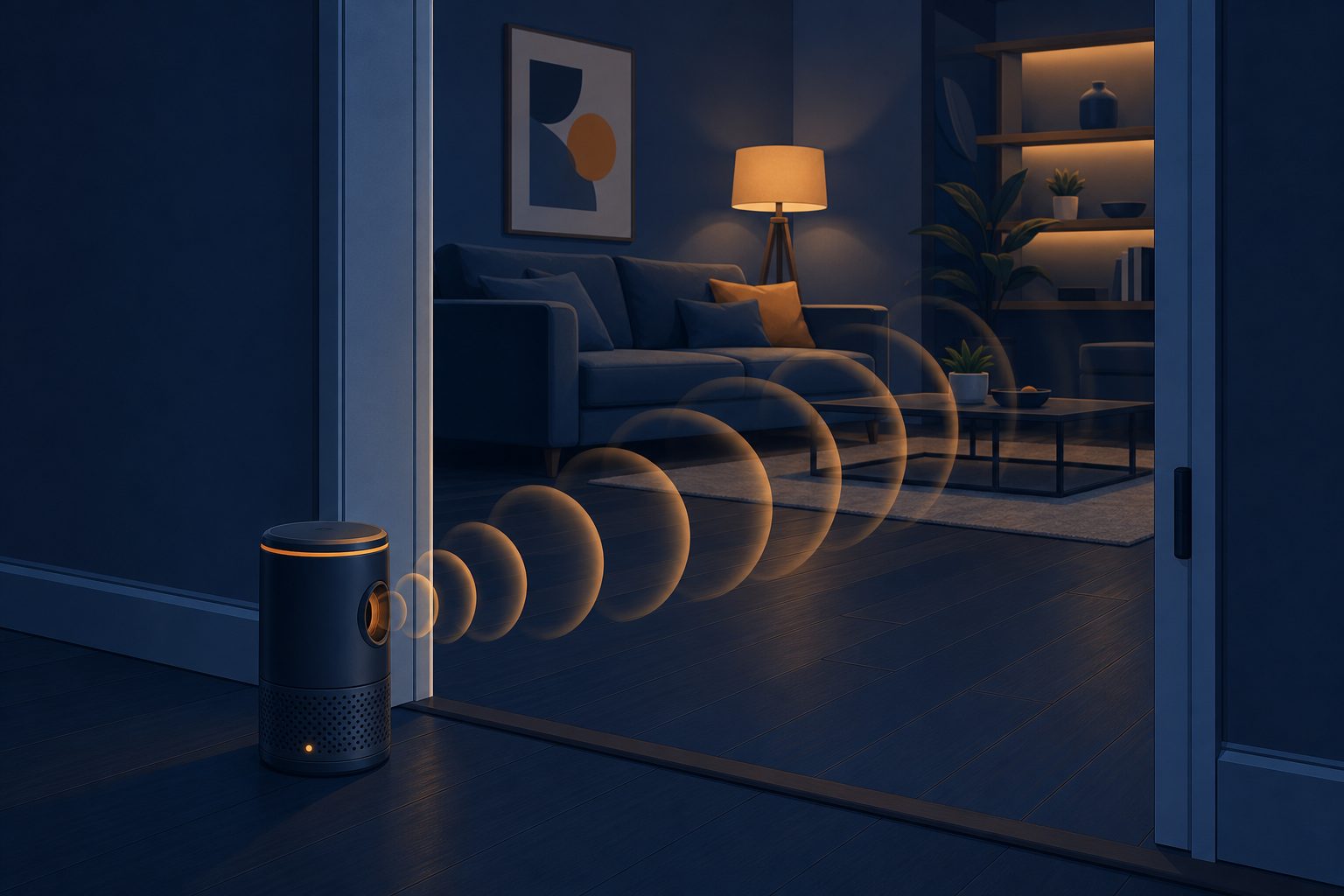
The unit is a compact air receiver that sits in the middle of a room. It releases a controlled pulse of air and measures how the building's internal pressure responds. From that response it calculates the air permeability of the whole envelope. Because it measures at close to normal atmospheric pressure, the result reflects how the building behaves in everyday conditions.
Setup is minimal: trickle vents closed, flues temporarily sealed, and the equipment carried in by hand. There is no doorway fan, no pressurising the house to artificial levels, and nothing invasive.
Pulse vs blower door: what is the difference?
| Pulse test | Blower door test | |
|---|---|---|
| Test pressure | Near-ambient, low pressure | 50 pascals, whole building pressurised |
| Equipment | Compact receiver unit, hand carried | Fan and frame sealed into a doorway |
| Setup | Minutes | Longer, door out of use during test |
| Occupants | Can stay in the property | Disruptive while the fan runs |
| Accepted for Part L | Yes | Yes |
| Accepted for RdSAP 10 EPC evidence | Yes, as a verified result | Yes, as a verified result |
Both methods are legitimate. Pulse's advantage is practical: speed and courtesy. On an occupied rental, that means a two-to-three-hour visit with the tenant at home, rather than an afternoon with the front door blocked by a fan.
Air testing on new builds: what Part L requires
Under Part L 2021, every new dwelling must be air tested, not just a sample of plots. The backstop limit is 8.0 m³/(h·m²) at 50Pa, but most SAP designs assume around 5.0 or better, so the real target is whatever your design air permeability says. Thermova provides results on the day and the ATTMA certificate within 24 hours, with a retest protocol if a plot misses its target. Details and a quote form are on our airtightness testing page.
Air testing on rentals: the EPC connection
On existing homes the same measurement does a different job. Most EPCs have never had an air test behind them, so the score carries an assumed worst-case default for air leakage. RdSAP 10, mandatory since 15 June 2025, allows a verified test result to replace that default. Where the building is tighter than assumed, the SAP score rises, and for certificates in the mid-to-high D band that is often the difference between a D and a C.
That is the engine behind the £500 no-C-no-charge EPC service: pre-screen the certificate, measure the real air leakage, and have a qualified Domestic Energy Assessor lodge the corrected EPC on the national register.
Frequently asked questions
What is a Pulse air tightness test?
How is Pulse different from a blower door test?
Is Pulse testing accepted for Building Regulations and EPCs?
How long does a test take?
Do tenants or occupants need to leave?
Next step
Need an air test, or a C on a rental?
Thermova runs ATTMA Level 1 accredited Pulse testing across the North West, for new-build Part L sign-off and for landlords using measured evidence to lift a D to a C.