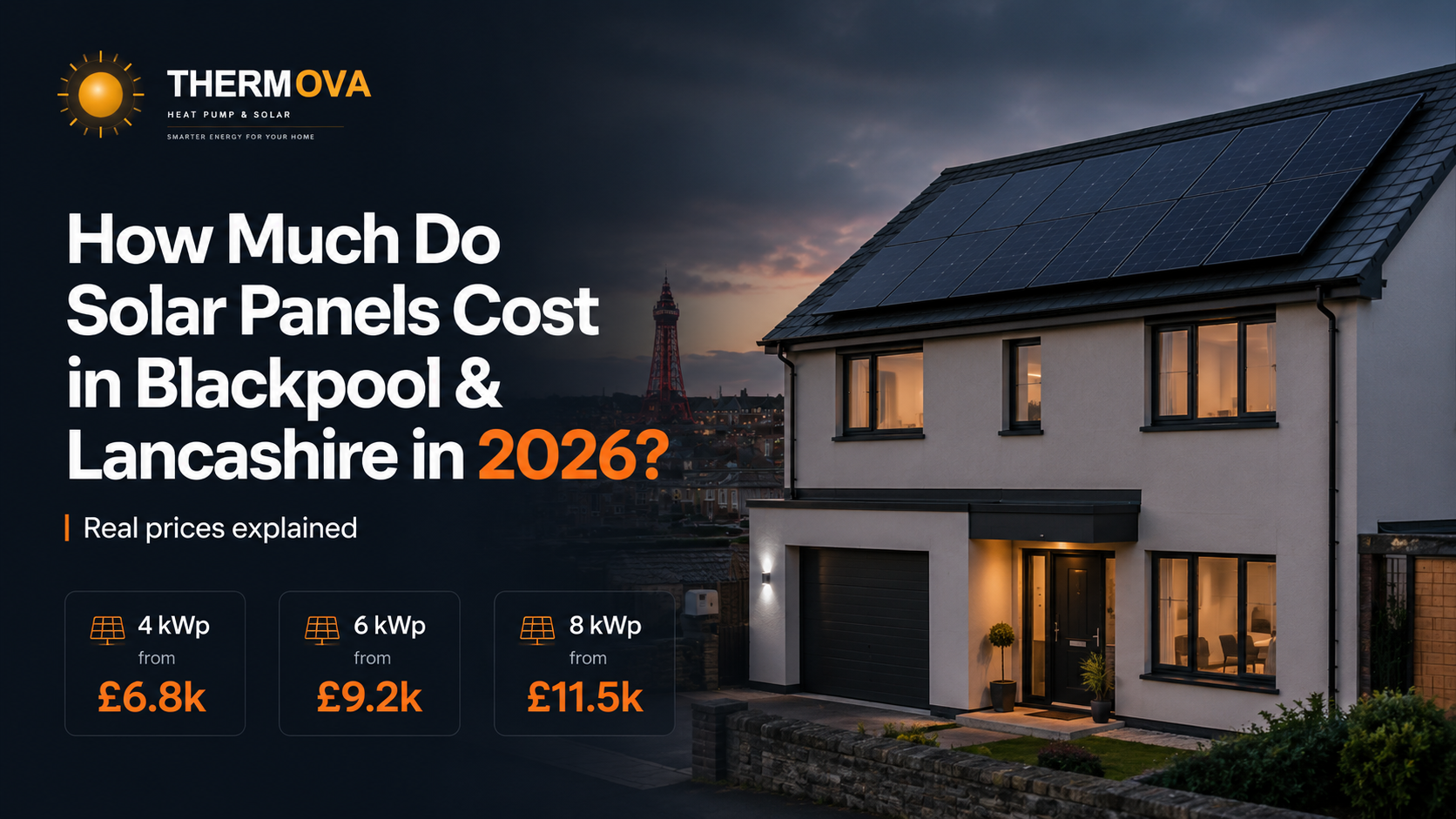
| System size | Annual generation (typical) | Property fit | Thermova 2026 price (0% VAT) |
|---|---|---|---|
| 3 kWp (7–8 panels) | ~2,600 kWh | Small terrace, low usage home | £5,500 – £6,800 |
| 4 kWp (10 panels) | ~3,500 kWh | Typical 3-bed semi (low–medium usage) | £6,800 – £8,500 |
| 5 kWp (12–13 panels) | ~4,400 kWh | 3-bed family home, gas heating | £8,000 – £9,800 |
| 6 kWp (15 panels) | ~5,200 kWh | 4-bed semi or small detached | £9,200 – £11,200 |
| 8 kWp (20 panels) | ~6,800 kWh | Large 4-bed detached, EV household | £11,500 – £14,000 |
| 10 kWp (25 panels) | ~8,500 kWh | Very large detached, EV + heat pump | £14,000 – £17,500 |
Generation figures assume a south-facing 35° pitch with limited shading — typical Fylde Coast generation is around 870 kWh per kWp per year, slightly above the UK domestic average. East- or west-facing roofs typically generate 80–85% of these figures.
Battery storage prices in Lancashire (2026)
Battery storage is the biggest single decision when buying solar in 2026. Adding a battery roughly doubles the financial benefit of solar by storing midday generation for the evening peak — but it adds significant upfront cost.
| Battery size | Suits | Thermova 2026 price (0% VAT) |
|---|---|---|
| 5 kWh | Small terrace, low evening usage | £3,500 – £4,500 |
| 10 kWh | Typical 3–4 bed family home | £5,500 – £7,500 |
| 13.5 kWh (e.g. Tesla Powerwall 3) | 4-bed+ household with EV or heat pump | £7,500 – £9,500 |
| 16 kWh+ (stacked LFP cells) | Large detached with EV + heat pump | £9,500 – £13,000 |
Standalone battery retrofits (no new solar) also qualify for 0% VAT until March 2027 — useful if you already have solar but no storage. Thermova quotes battery-only retrofits as a separate service.
Total system prices: solar + battery (the most common Thermova install)
| Property type | Typical package | All-in 2026 price (0% VAT) |
|---|---|---|
| 3-bed semi (Lytham, Preston, Poulton-le-Fylde) | 4 kWp solar + 5 kWh battery | £10,500 – £13,000 |
| 3-bed detached (Cleveleys, Bispham) | 5 kWp solar + 10 kWh battery | £13,500 – £17,000 |
| 4-bed detached (Lytham St Annes, Fleetwood) | 6 kWp solar + 10 kWh battery | £14,500 – £18,500 |
| 4–5-bed detached + EV (Fylde rural) | 8 kWp solar + 13.5 kWh battery | £19,000 – £23,500 |
| Large detached + EV + heat pump | 10 kWp solar + 16 kWh battery | £23,500 – £30,500 |
These are the price brackets Thermova consistently quotes against in Lancashire. They’re mid-market. Some installers will quote less — usually by cutting on panel quality, inverter tier, battery brand, or warranty length. Some will quote more — usually because they’re bundling in items you may not need.
What’s included in every Thermova solar quote
- Pre-quote roof survey (orientation, pitch, shading analysis, structural integrity check)
- Solar panels (Tier 1 monocrystalline, typically 405–435 W per panel in 2026)
- Hybrid inverter sized correctly to the array (Thermova’s default brands listed in our brand comparison guide)
- Battery storage with full integration (where included)
- Mounting, scaffolding, all cabling (AC and DC)
- DNO notification (the network operator approval — Thermova handles this in full)
- MCS certification and full installation paperwork
- Smart Export Guarantee setup support
- Live monitoring app for real-time generation and consumption tracking
- Workmanship warranty (Thermova’s 2-year install warranty on top of manufacturer warranties)
What’s NOT included (and might catch you out elsewhere)
Transparency matters more here than the headline price. These items are sometimes priced separately by less scrupulous installers and added at the deposit-to-install stage. Thermova flags any of these during the survey:
- Major roof repair if the survey identifies tiles or felt close to end-of-life — better fixed before panels go up
- Electrical consumer unit upgrades if your current board is too old to accept solar isolators
- EV chargers (typically £900–£1,200 fitted, can be bundled at 0% VAT alongside solar)
- Bird mesh to stop pigeons nesting under panels — usually quoted as an optional extra (£250–£400 for a typical array)
- Builders’ work if the inverter or battery needs a new dedicated space (rare)
The 0% VAT deadline: why it matters in 2026
Since April 2022, all UK domestic solar PV and battery storage installations have been zero-rated for VAT. That relief is scheduled to expire on 31 March 2027, after which the rate reverts to 5% (HMRC VAT Notice 708/6).
What this means for Lancashire homeowners considering solar in 2026:
- A typical £14,000 solar and battery install will cost £700 more after April 2027 at the 5% rate
- Larger £20,000+ packages will cost £1,000+ more — that’s a year of bill savings lost to VAT alone
- VAT is determined by invoice/completion date — to lock the 0% rate, the install must complete before 1 April 2027
- Installer lead times typically lengthen as deadline approaches; committing by late 2026 is the safer plan
There is no guarantee the relief will be extended. Treasury could extend it (and has extended energy-saving-materials relief before), but the only sensible plan is the published deadline. Are there solar panel grants in Lancashire? There is no direct cash grant for retrofit solar PV for most Lancashire homeowners in 2026. The financial incentives that are available:
- 0% VAT until 31 March 2027 — effectively saving £400–£1,200 depending on system size
- Smart Export Guarantee (SEG) — typically 4–15p per kWh exported, paid by your electricity supplier (Octopus, E.ON Next, EDF and others)
- ECO4 / Warm Homes: Local Grant — fully funded solar PV installs for low-income households (eligibility based on benefits, income or EPC rating). Thermova checks eligibility free of charge during the survey
- Tax-free SEG income under HMRC rules where your system generates less than 120% of household usage
For commercial properties (offices, warehouses, workshops), separate business solar finance and tax allowances apply — including the Annual Investment Allowance for the full install cost in year one. Thermova quotes commercial solar separately.
Three real Lancashire solar quote examples (2026)
Example 1: 3-bed semi, Preston — 4 kWp solar + 5 kWh battery
| Property | 3-bed semi-detached, gas combi heating, no EV |
|---|---|
| Annual electricity use | 3,800 kWh |
| System | 4 kWp solar (10 × 405 W JA Solar panels) + 5 kWh Fox ESS battery |
| Annual generation | ~3,500 kWh |
| Self-consumption (with battery) | ~70% |
| Total install price (0% VAT) | £11,400 |
| Estimated year-one bill saving | ~£890 |
| Estimated SEG income | ~£130 |
| Simple payback | ~11 years |
| Install duration | 1.5 days |
Example 2: 4-bed detached, Lytham St Annes — 6 kWp solar + 10 kWh battery
| Property | 4-bed detached, gas heating, one EV, two adults working from home |
|---|---|
| Annual electricity use | 6,200 kWh (including EV charging) |
| System | 6 kWp solar (15 × 410 W panels, split SE/SW pitches) + 10 kWh Fox ESS battery + smart EV charger |
| Annual generation | ~5,200 kWh |
| Self-consumption (with battery + EV) | ~80% |
| Total install price (0% VAT) | £16,200 |
| Estimated year-one bill saving | ~£1,310 |
| Estimated SEG income | ~£180 |
| Simple payback | ~10.5 years |
| Install duration | 2 days |
Example 3: Large detached, rural Fylde — 8 kWp solar + 13.5 kWh battery
| Property | 5-bed rural detached near Garstang, oil heating (heat pump planned 2027), EV |
|---|---|
| Annual electricity use | 8,400 kWh (EV + electric tools/workshop) |
| System | 8 kWp solar (20 × 415 W panels, single south-facing pitch) + 13.5 kWh Tesla Powerwall 3 |
| Annual generation | ~6,950 kWh |
| Self-consumption (with battery + EV) | ~82% |
| Total install price (0% VAT) | £21,200 |
| Estimated year-one bill saving | ~£1,720 |
| Estimated SEG income | ~£220 |
| Simple payback | ~10 years |
| Install duration | 2.5 days |
Note the payback periods all sit in the 9.5–11 year range at 2026 electricity prices. If prices rise (the safer assumption), payback shortens. After payback, the systems continue generating for at least another 15+ years under the panel warranty — total lifetime savings typically exceed 3× the install cost for properties in this bracket.
Financing solar in Lancashire
Most Lancashire homeowners pay for solar in one of three ways:
- Cash / savings — the cheapest route long-term, no interest costs
- Solar finance loan (typically 5–15 year term, 6–9% APR) — monthly payment is usually lower than the bill saving, so the system pays its own loan repayments
- Remortgage or further advance on the property — often the lowest rate, particularly if you have equity
Thermova works with a panel of green-finance providers and provides indicative finance illustrations alongside every quote — so you can see whether the monthly payment beats your current electricity bill.