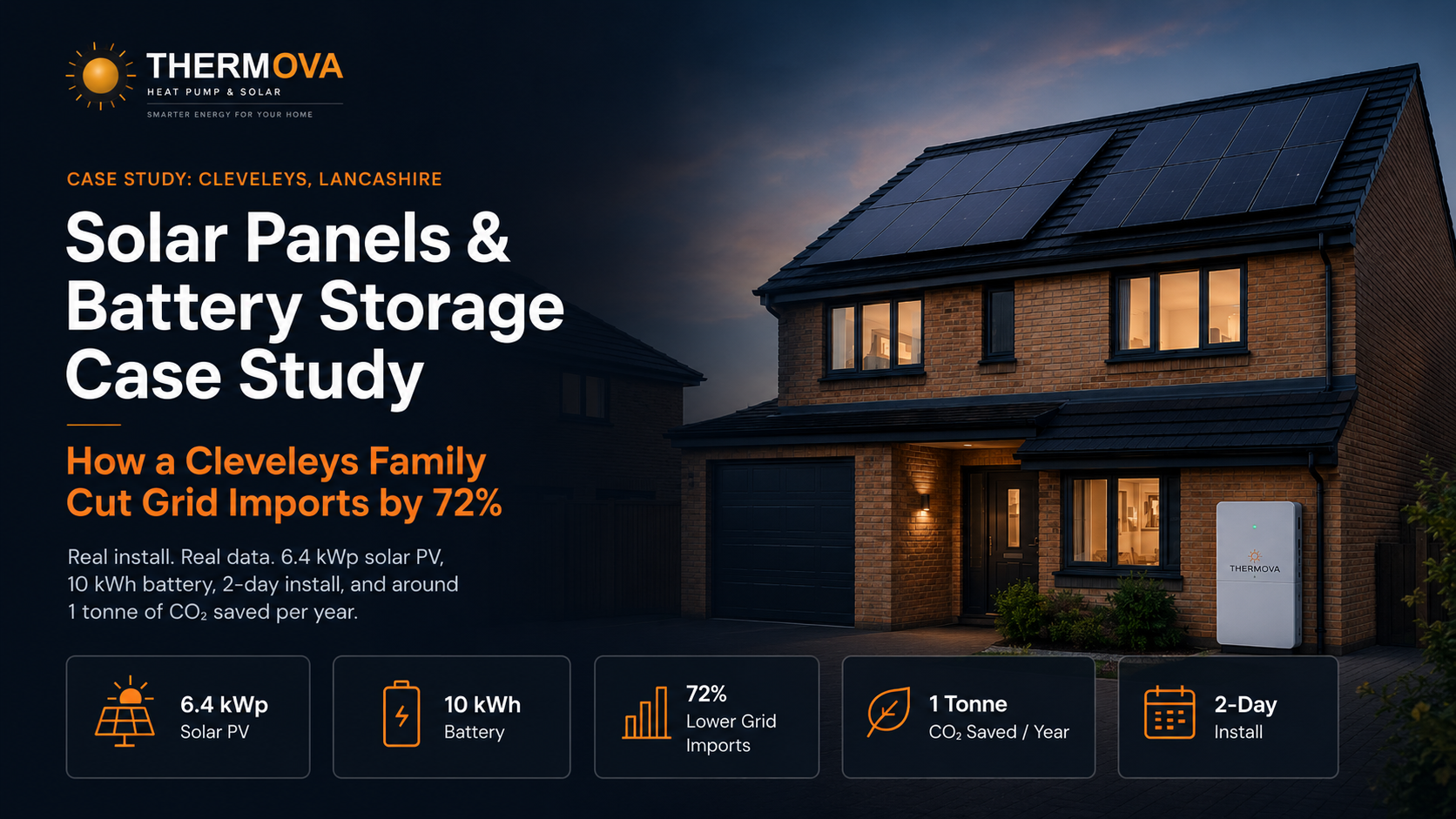
- 6.4 kWp solar PV array: 16 × 400 W monocrystalline panels (8 on each pitch), 25-year performance warranty
- Hybrid solar inverter capable of running essential loads during a grid outage (back-up gateway included)
- 10 kWh lithium iron phosphate (LFP) battery: 6,000-cycle warranty, indoor-rated, mounted in the garage
- Smart EV charger integrated with solar and battery for surplus charging only when the sun is out
- Live monitoring app showing real-time generation, consumption, battery state-of-charge and grid flow
- MCS-certified design and install with full DNO notification handled by Thermova
- 0% VAT applied under the UK Energy-Saving Materials VAT relief
How long did the solar and battery installation take? 2 working days. Scaffolding up Monday morning. Panels and rails fitted Monday. Inverter, battery, EV charger and commissioning Tuesday. Scaffolding down Wednesday morning. The system was exporting to the grid by Tuesday afternoon. This is typical for a Thermova solar and battery installation in Lancashire: a 1.5 to 2-day job for most domestic systems on a single roof, sometimes longer for complex multi-roof or in-roof installs.
Year-one performance data
System commissioned April 2025. Twelve months of metered data follows.
| Metric | Year-one result |
|---|---|
| Solar generation (total) | 5,420 kWh |
| Self-consumption (direct) | 2,180 kWh |
| Self-consumption (via battery) | 2,000 kWh |
| Total self-consumption | 4,180 kWh (77% of generation) |
| Exported to grid (SEG) | 1,240 kWh |
| Grid imports (post-install) | 1,620 kWh |
| Grid imports (pre-install) | 5,800 kWh |
| Grid import reduction | −4,180 kWh (−72%) |
| Annual CO₂ saved (avoided imports) | 807 kg |
| Annual CO₂ saved (grid export offset) | 239 kg |
| Total CO₂ saved per year | 1,046 kg (≈ 1 tonne) |
A few notes for transparency:
- Generation figure comes from the inverter’s CT clamp on the AC output.
- Self-consumption split comes from the hybrid inverter logging direct PV use vs. battery discharge.
- CO₂ figures use the latest UK grid factor of 0.193 kg CO₂e per kWh.
- Generation per kWp worked out at 847 kWh/kWp, consistent with a split-pitch Lancashire roof and in line with typical UK domestic yields.
What the system saved on bills
| Item | Amount |
|---|---|
| Electricity import bill (pre-install) | ~£1,624 (5,800 kWh × 28p) |
| Electricity import bill (post-install) | ~£454 (1,620 kWh × 28p) |
| Bill reduction | −£1,170/year |
| SEG export income (1,240 kWh × 15p) | +£186/year |
| Total year-one financial benefit | £1,356 |
The household didn’t change behaviour to get those numbers. They didn’t time the dishwasher or move the tumble drier to noon. The battery did the time-shifting automatically, storing midday surplus for the family’s 4 to 9 pm peak usage. That said, with smart-tariff scheduling and EV charging optimisation, year-two savings are projected to climb to £1,500 to £1,700.
What it cost, and the payback maths
| Item | Cost |
|---|---|
| 6.4 kWp solar PV | £6,800 |
| 10 kWh battery + hybrid inverter | £6,400 |
| EV charger integration | £1,000 |
| Total install (0% VAT) | £14,200 |
Simple payback: £14,200 ÷ £1,356 = 10.5 years at year-one savings. With electricity prices likely to rise and the family’s EV usage growing, the realistic payback is closer to 8 to 9 years. After payback, the system continues generating for at least another 15 to 17 years under the panel warranty. Total lifetime savings come in well above £30,000 at current tariffs, more if grid prices rise (which is the safer assumption).
What 1 tonne of CO₂ a year actually means
The Cleveleys system saves around 1,046 kg of CO₂ per year. To give that some scale:
- Equivalent to about 4,000 miles in a UK petrol car (more than the family’s annual EV mileage offset)
- Roughly 1.2 return flights London to Madrid
- The annual carbon sequestered by about 50 oak saplings growing to maturity
Across 25 years of system life, that’s 26+ tonnes of avoided CO₂, without anyone in the household doing anything different.
Frequently asked questions
How much do solar panels and a battery cost in Blackpool or Lancashire?
How much can I save with solar panels and a battery in Lancashire?
How long does solar panel installation take in Lancashire?
Do solar panels work on the Fylde Coast?
Is there a grant for solar panels in Lancashire?
Do I need a battery, or are solar panels enough on their own?
What is the Smart Export Guarantee?
Is your Lancashire home suitable for solar and battery?
Next step
Get a free Thermova solar and battery quote
Every Thermova solar and battery installation includes a full performance projection, covering modelled generation, self-consumption, SEG export, payback and CO₂ savings, before you commit to anything. We use real Lancashire weather data and your real consumption profile, not generic UK averages. Book your free home survey and you’ll get the same data shown above, projected for your own roof and household.
- → Get your free Thermova solar and battery quote: thermova.uk/contact
- → Read the Air Source Heat Pump Case Study (linked separately)
- → See the Combined Heat Pump + Solar + Battery Case Study (linked separately)